For a bulletin, memorial card, retreat handout, or small-group reading, we recommend linking to the passage rather than reproducing a long text block. The steps below cover choosing the destination, preparing the design, and checking permissions if you also publish Scripture text.
1. Choose what the scan should open
Start with the reader’s task, not the QR design.
| What you want to share | Suggested destination |
|---|---|
| One verse or a continuous passage | The specific passage page in the intended translation |
| Several readings for one service | A public church page listing the references and links |
| A weekly reading schedule | A page your organization maintains at a consistent address |
| A YouVersion church event | The event’s official sharing link |
YouVersion’s Events documentation says its event links open in the Bible App for people who have it, or at Bible.com for those who do not. Treat that as the documented behavior—not a guarantee for every phone or embedded browser—and test your audience’s likely access paths. [2]
For a keepsake or reusable handout, prefer a destination you intend to maintain. Do not assume a third-party passage page or event link will remain available indefinitely.
2. Copy and check the passage link
Here is a practical workflow using Bible Gateway’s documented tools:
- Search for the reference, such as John 3:16 or Psalm 23.
- Select the translation you intend readers to use.
- For an individual verse, select it and use Share to copy its link. These search, translation, and sharing functions are described in Bible Gateway’s tutorial. [1]
- For a passage page, copy the page address after confirming the displayed passage and translation.
- Open the copied address in a private or signed-out browser window before generating the code.
During that check, confirm the book, chapter, verse range, language, and translation. Also check whether the intended reading is accessible without your personal account. Avoid sharing an editing screen, private study note, or account-specific page.
Example label: “Scan to read Psalm 23 — World English Bible.” This identifies the intended destination even before someone scans.
3. Generate the code from the final URL
In your chosen QR generator:
- Choose its URL or website option.
- Paste the checked link—not the verse reference alone.
- Generate the code and download an image suitable for your layout.
- Keep the source URL, translation name, and image file together in your production notes.
These are generic steps, not instructions for a particular generator interface. Before committing to a service, check whether it encodes your destination directly or uses an intermediary link, and review any ongoing service requirements.
Keep unnecessary content out of the encoded data. DENSO WAVE explains that increasing the amount of data can require more modules—the small squares that make up the symbol. This is one reason to favor a passage link over a long copied reading. [3]
4. Add a useful label and a non-scanning alternative
Make the purpose explicit. Suggested labels include:
- Scan to read today’s passage: Luke 15:11–32
- Scan for this week’s reading schedule
- Scan to open the service readings
Print the reference and translation outside the code. Where practical, include a readable destination address or brief navigation instruction as a fallback.
For a digital bulletin, make the accompanying text clickable too. Do not make scanning a code the only route to the reading, especially when someone may already be viewing the bulletin on a phone.
5. Protect the code’s clear border and test its size
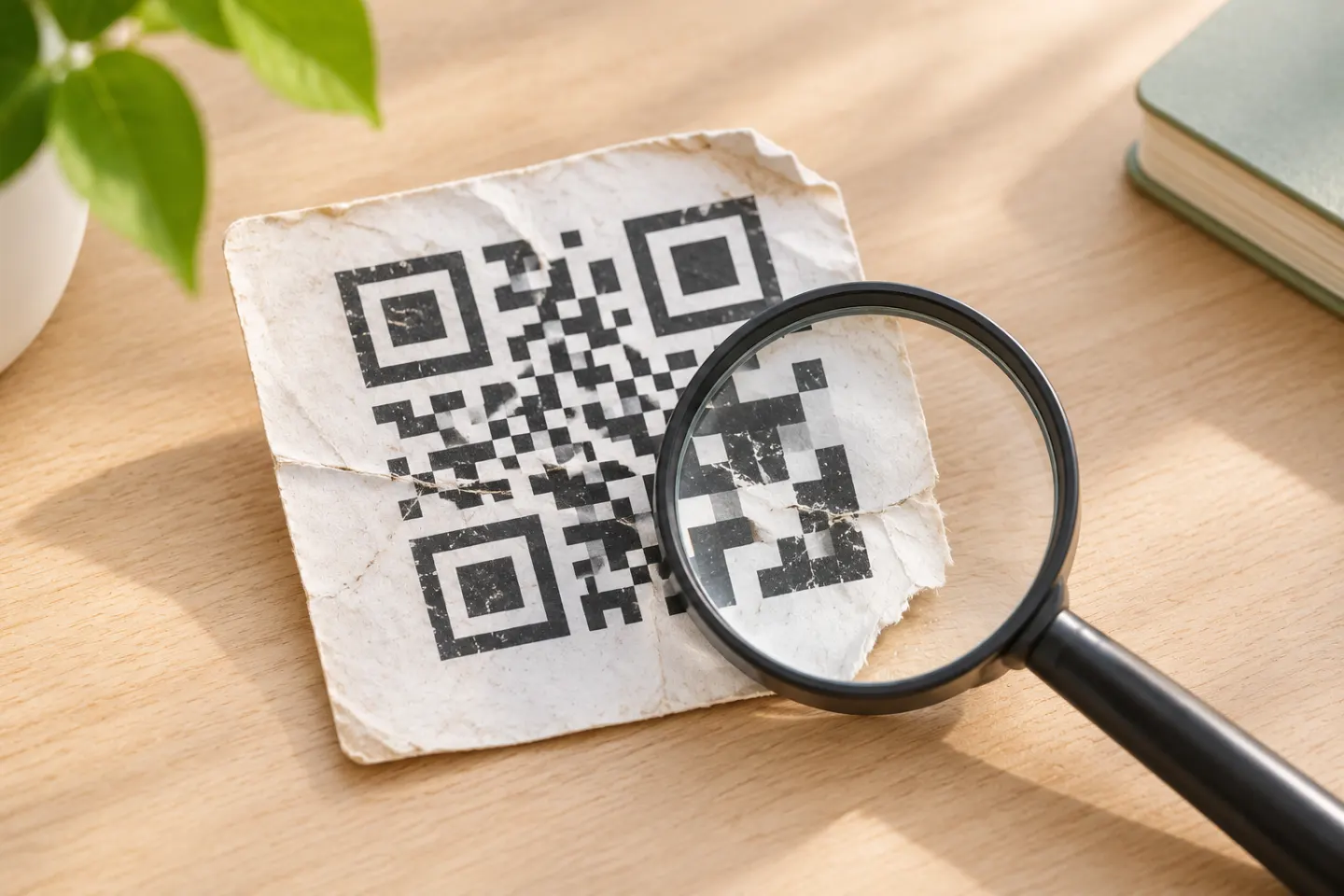
A standard QR code needs a clear border, called a quiet zone, at least four modules wide on every side. Keep text, decorative frames, and background graphics outside that space. [4]
DENSO WAVE also explains that larger modules are easier for scanners to read and that appropriate sizing depends on printing and scanning conditions. There is no single physical size that this article can promise will work for every bulletin, card, or projected slide. [5]
For your first proof, use a plain black-on-white design without a logo overlay, keep it square, and avoid shrinking it simply to fill a leftover gap. Then test the actual output rather than relying only on the generator preview.
If you also print or publish the verse text
Link sharing and text reproduction are different production choices. Use the platform’s documented sharing tools for links. If you copy Scripture into your handout, graphic, PDF, or destination page, check that translation’s current permissions for that particular use.
Two examples illustrate why the translation matters:
- World English Bible: Its publisher identifies the text as public domain and permits electronic and print copying. Its FAQ separately explains that altered text should not retain the World English Bible name. [6]
- NIV: Check Biblica’s current permissions for your use and include the required acknowledgment if you reproduce the text. [7]
Do not treat those quotation limits as blanket permission to build a Scripture website, distribute recordings, or sell verse merchandise. Biblica provides additional licensing guidance for those uses. Ask the rights holder when your format or purpose is unclear. This is a publishing checklist, not legal advice. [7]
Final checklist before distribution
Complete these checks yourself; they are not tests performed for this article:
- Open the destination while signed out.
- Verify the exact passage and translation.
- Scan the final printed proof on both an iPhone and an Android phone if available.
- For a projected slide, test from realistic audience positions.
- Confirm the quiet zone survived layout and export.
- Check that the reference, label, and fallback route are readable.
- Record any required text permissions and acknowledgment.
- Assign someone to recheck the destination before reusing the design.
A strong default: one checked passage link, one clearly labeled QR code, and the verse reference printed beside it. Add a maintained reading page when you need multiple passages or an ongoing schedule—not merely to make a simple verse share more complicated.
References
[1] Bible Gateway — Tutorial — https://www.biblegateway.com/help/tutorial
[2] YouVersion — Events resources — https://www.bible.com/features/events-resources
[3] DENSO WAVE — Information capacity and versions of QR Code — https://www.qrcode.com/en/about/version.html
[4] DENSO WAVE — Point for determining the code area — https://www.qrcode.com/en/howto/code.html
[5] DENSO WAVE — Point for setting the module size — https://www.qrcode.com/en/howto/cell.html
[6] World English Bible — Publisher information — https://worldenglish.bible/
[7] Biblica — Permissions — https://www.biblica.com/permissions/