First, find the cleanest version
Before editing the code, look for a better source:
- Reopen the original image or file instead of a screenshot of a screenshot.
- If the code is printed, check whether the person or business that supplied it can send the original file or a new print.
- If you control the QR code, use the original encoded destination or data to generate a fresh code. Do not recreate the destination from memory if it contains a long URL, payment details, or other exact text.
- If you only need the destination, ask the owner for the direct link through a contact channel you already trust.
A clean source is safer and more reliable than repeatedly sharpening a degraded copy. A QR code’s built-in error correction can help with some dirt or damage, but its ability to restore data depends on how much of the code is affected.[1]
Try these steps on a blurry QR code image
Keep the untouched file. Make a duplicate before changing anything so you can compare each attempt with the original.
- Show the whole code. Make sure the three large corner markers and the full square are visible. Do not crop into the code or its clear border.
- Improve the capture. If you are photographing a screen or print, hold the camera steady, let it focus, reduce glare, and move until the code is sharp and large in the frame.
- Try a different view of the same image. If the code is tilted, rotate the duplicate so its edges are level. If shadows or a color cast obscure the pattern, try a simple grayscale or contrast adjustment. Change one thing at a time and keep the original for comparison.
- Scan the original and each version. Use your phone’s built-in camera or a QR reader you trust. A second scanner can help identify whether the issue is the first scanner’s focus or compatibility, but a result is not proof that the destination is safe.
- Stop if the pattern is still unclear. If the small squares have blended together, the code is cut off, or damage covers important parts, more enhancement may not recover the encoded data. Get a clean copy or direct destination instead.
Image editing can make an existing pattern easier to see; it cannot reliably invent data that is missing. Avoid tools that claim they can reconstruct a QR code without confirming the decoded result against the original source. Generative image enhancement is especially unsuitable for recovering exact links or payment information because it may change details.
What if the QR code is physically damaged?
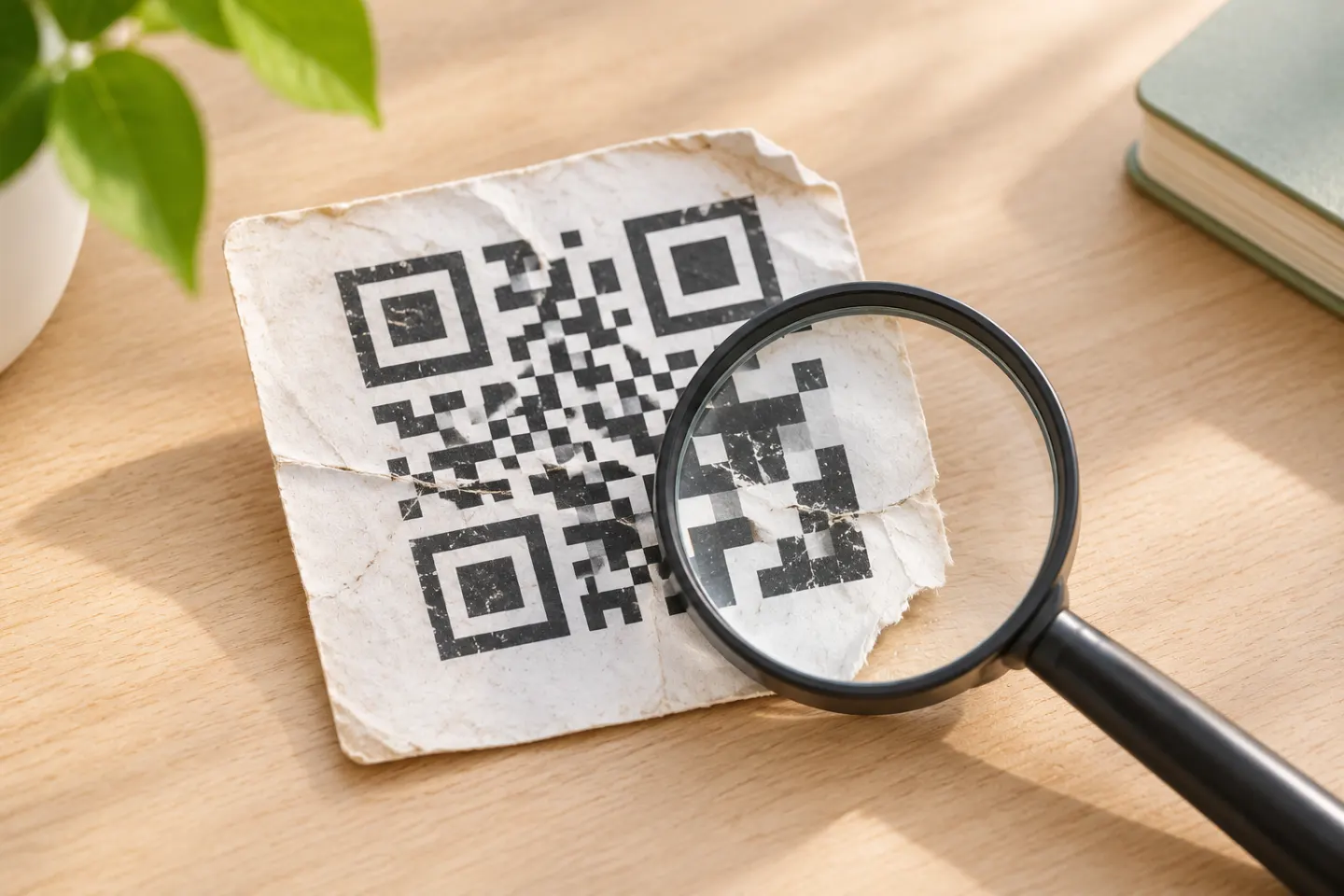
For a printed code, check whether dirt, a fold, a tear, a sticker, or worn ink obscures the pattern. If the code is only lightly marked, a scanner may still read it because QR codes have error correction. The result depends on the amount and location of the damage; error correction is not a guarantee that a badly damaged code will work.[1]
Try scanning a clean photograph of the code in good light. If that fails, do not keep altering or guessing the pattern. Ask for a new print or the direct URL. If the code belongs to you, regenerate it from the exact original data and test the new version before replacing the old one.
Why some QR codes cannot be recovered
A QR code stores information in a grid of dark and light modules. Error correction adds data that can help a reader restore some information when part of the code is dirty or damaged. DENSO WAVE explains that the correction capability depends on how much data needs correction; choosing a higher correction level also increases the QR code’s data amount and size.[1]
This is why “blurry” is not one single problem. A camera may be out of focus even though the code file is intact. A small or compressed image may have lost the crisp edges that distinguish the modules. A physical tear may cover part of the pattern. A cropped image may remove a necessary section. These cases call for different next steps: improve the capture for focus or glare, return to the original for compression, or replace the code if information is missing.
An enhancement tool may improve contrast or make a code easier for a scanner to interpret. That is different from recovering a known, verified destination. Do not assume a tool’s newly drawn image contains the original data unless you can scan it and confirm the result with the code owner or a trusted source.
If you created the QR code, make a reliable replacement
If the code is yours and you still have the exact payload—the URL, text, contact record, or other data—create a fresh code from that source rather than trying to repair a badly degraded output.
Before distributing or printing it:
- Confirm the encoded content is correct.
- Keep the code’s full pattern and surrounding clear space visible in the design.
- Use a clean, high-quality source file when resizing it.
- Scan the final file or a physical proof with more than one device, at the size and distance people will actually use.
- Keep a copy of the original data and final code so you can replace it if needed.
These are practical checks, not a universal print-size or DPI formula. Results depend on the code’s content, final size, display or print quality, scanner, distance, and lighting. If a code needs to work in a demanding setting, test the actual final version under those conditions.
Quick decision guide
| What you have | Best next step |
|---|---|
| A screenshot or compressed image | Find the original file; then try a duplicate with one simple adjustment at a time |
| A code that looks soft in the camera | Refocus, steady the phone, reduce glare, and capture the whole code |
| A print with light dirt or a small mark | Try scanning a clear photo; error correction may help, but success is not guaranteed |
| A code with a tear, missing corner, or merged modules | Ask for a clean copy or direct link |
| A code you created and can edit | Generate a fresh code from the exact original data and test the final version |
| A tool-produced “restored” code | Scan it and verify the destination independently before using it |
Frequently asked questions
Can an AI tool unblur any QR code?
No tool can guarantee recovery of every QR code. Image processing may make an existing pattern easier to read, but it cannot reliably determine data that has been lost or covered. Treat a generated reconstruction as unverified until its contents are checked against the original source.
Does QR code error correction mean a damaged code will always scan?
No. Error correction can restore some data when a code is dirty or damaged, but the capability depends on how much data must be corrected. Severe blur, missing sections, or damage may exceed what the code can recover.[1]
What should I do if no scanner can read it?
Stop editing the same copy. Ask the person or business that supplied it for a clean image, a replacement print, or the direct destination. If you created the code, regenerate it from the exact source data and verify the result.
References
[1] DENSO WAVE. Error Correction Feature. https://www.qrcode.com/en/about/error_correction.html