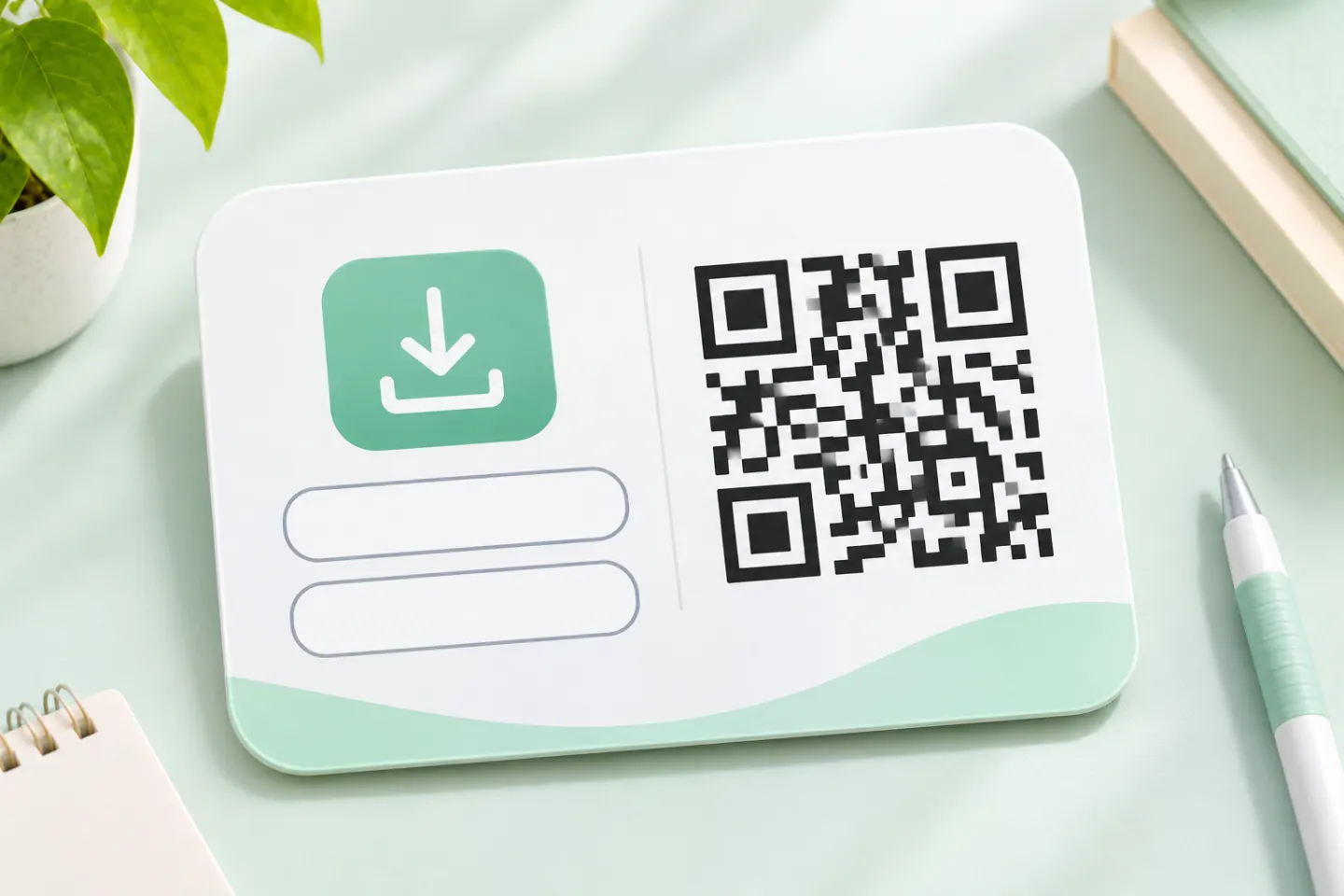
For a campaign covering both platforms, our recommended starting point is one QR code linking to a simple download page with clearly labeled App Store and Google Play buttons. Treat automatic device-based routing as an optional enhancement—not a prerequisite.
1. Choose the destination before generating the code
For an iPhone or iPad app
Use your app’s App Store product-page link. Apple’s official App Store marketing tools offer short links and embeddable assets displaying an app icon, QR code, or App Store badge. These are documented capabilities, not a claim that we tested the tool’s current interface. [1]
Before creating the artwork, open the destination and confirm the app name and publisher. For a US campaign, include US availability and supported devices in your launch checks.
For an Android app on Google Play
Use the specific app-listing URL—not a store search or your developer’s entire catalog. Google documents this format:
https://play.google.com/store/apps/details?id=<package_name>
Replace <package_name> with the app’s actual package name. Google identifies this URL as the route to the listing containing the app description, screenshots, reviews, and installation option. [2]
For one QR code covering both platforms
Our recommended layout is a mobile-friendly page containing:
- The app’s name and a brief description.
- A clearly labeled App Store link.
- A clearly labeled Google Play link.
- A short explanation if one platform is unsupported.
Ask your developer to add automatic routing only if the campaign needs it. Make the manual store choices easy to reach if routing fails or selects the wrong destination. This is an editorial design recommendation, not an Apple or Google requirement.
2. Decide whether the destination needs to change later
You have two practical approaches:
| Approach | Recommended use |
|---|---|
| Encode the official store URL directly | A single-platform campaign with a settled destination |
| Encode a stable download-page or redirect URL you control | A cross-platform campaign or printed material that may need destination updates |
With the second approach, the printed pattern stays the same while you maintain the page or redirect behind its URL. The flexibility comes from that web layer—not from altering the printed code. GS1’s explanation of QR redirection describes this separation between an encoded URL and the final content destination; its product-identification rules are outside this tutorial’s scope. [3]
If you choose the flexible approach, assign someone to maintain the domain, hosting, links, and redirect rules for as long as the printed material remains in circulation.
3. Generate the QR code from the final URL
Use this tool-independent workflow:
- Finalize the destination. Choose the official store link or your download-page URL.
- Open it yourself. Confirm that it leads to the intended app or download choices.
- Select URL or website input in your QR tool. Paste the complete HTTPS address, including any approved campaign parameters.
- Generate and export the image. Follow your designer’s or printer’s file requirements.
- Place it in the finished layout. Do not approve only the isolated QR image; test the version people will actually see.
Apple’s marketing tools are another documented option for App Store QR assets. No particular QRHyper interface, export format, redirect feature, or analytics capability is assumed here. [1]
Keep the code’s border clear
A standard QR Code needs a blank quiet zone at least four modules wide on every side. A module is one of the small squares making up the symbol. Keep captions, borders, and artwork outside that area. [4]
Do not substitute an App Store badge’s spacing rules for QR-code requirements. DENSO WAVE explains that QR size depends on the symbol version, module size, and margin, and that printer and reader capabilities affect module-size choices. Its guidance also warns that distortion or decoration can make codes unreadable. Choose the final size using a print proof. [4][5][6]
4. Add a specific call to action and a backup link
Suggested copy:
- Scan to get the Acme app — for a page offering both stores.
- Scan for the iPhone app — for an App Store-only destination.
- Scan for the Android app on Google Play — for a Google Play-only destination.
Include the app’s name so readers know what they are opening. If you use an App Store badge, use Apple’s approved assets and follow its marketing guidelines. [7]
For printed materials, we recommend a readable backup web address beside the code. For email, websites, and social placements, include a tappable link as well rather than requiring everyone to scan.
5. Keep scan reporting separate from download attribution
Plan measurement before approving the artwork. Do not report QR-link visits as confirmed app installs: Apple’s campaign reporting and Google’s installation-referrer tooling measure events beyond simply opening a URL. [8]
For iOS, App Store Connect supports campaign links containing campaign and provider tokens. Use the generated link as the QR destination or the relevant landing-page button. Apple applies reporting thresholds, so do not expect every individual test visit to appear in campaign reports. [8]
For Android, ask your developer or analytics owner to define the attribution setup. Google’s Install Referrer API can retrieve referral information and installation timestamps, but it requires implementation; generating a QR image does not implement it. [9]
6. Test the complete journey before publishing
Use this as a recommended acceptance checklist—not a report of tests performed for this article:
- Scan the finished artwork on an iPhone and a representative Android device.
- Confirm the app name, publisher, store destination, and installation availability for the intended audience.
- For a shared download page, test both store buttons and the manual fallback.
- If using automatic routing, test phone, tablet, and desktop visits.
- Test relevant social-app browsers separately from the normal browser.
- Print a proof at the intended size and test under expected lighting and viewing conditions.
- Check the backup address and any approved campaign parameters.
For a single-platform campaign, the opposite-platform check should confirm that the limitation is understandable—not that an incompatible app can be installed.
Do you need deep links for an app download QR code?
Not for a basic link to a store listing. Android App Links and Apple universal links associate web addresses with in-app content. For a basic install campaign, send people to the store listing or to a page that shows the available stores. [10][11]
Bottom line: Start with the correct store destination. Use a shared download page when readers need both platform choices, preserve the QR quiet zone, and approve the artwork only after testing the full journey.
References
[1] Apple Developer — Promoting your apps and games — https://developer.apple.com/app-store/promote/
[2] Android Developers — Linking to Google Play — https://developer.android.com/distribute/marketing-tools/linking-to-google-play
[3] GS1 — Redirection: from scan to content — https://ref.gs1.org/docs/2024/redirection-from-scan-to-content
[4] DENSO WAVE — Point for determining the code area — https://www.qrcode.com/en/howto/code.html
[5] DENSO WAVE — Generating a QR Code — https://www.qrcode.com/en/howto/generate.html
[6] DENSO WAVE. Point for setting the module size. https://www.qrcode.com/en/howto/cell.html
[7] Apple Developer — Marketing Resources and Identity Guidelines — https://developer.apple.com/app-store/marketing/guidelines/
[8] Apple Developer — Campaign links — https://developer.apple.com/help/app-store-connect-analytics/acquisition/campaign-links
[9] Android Developers — Google Play Install Referrer — https://developer.android.com/google/play/installreferrer
[10] Android Developers. About Android App Links. https://developer.android.com/training/app-links
[11] Apple Developer. Supporting universal links in your app. https://developer.apple.com/documentation/xcode/supporting-universal-links-in-your-app