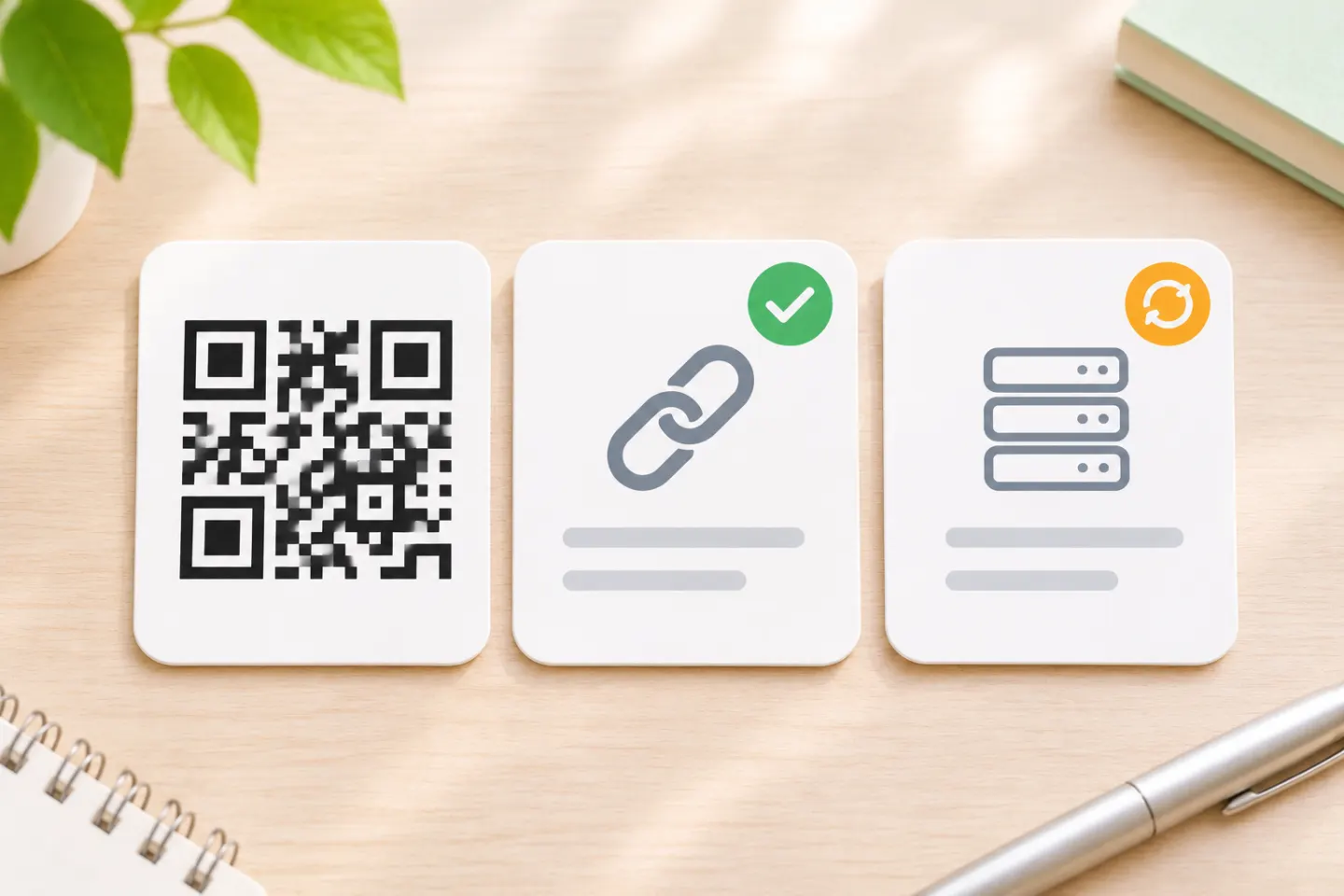



But “static” does not mean the linked webpage must stay unchanged. You can update that page—or manage your own redirect—without replacing the QR image. The important distinction is fixed encoded data versus changeable web behavior, not permanent content versus editable content. This follows from how URL redirection works. [2]
What actually changes in a dynamic QR code?
For ordinary website links:
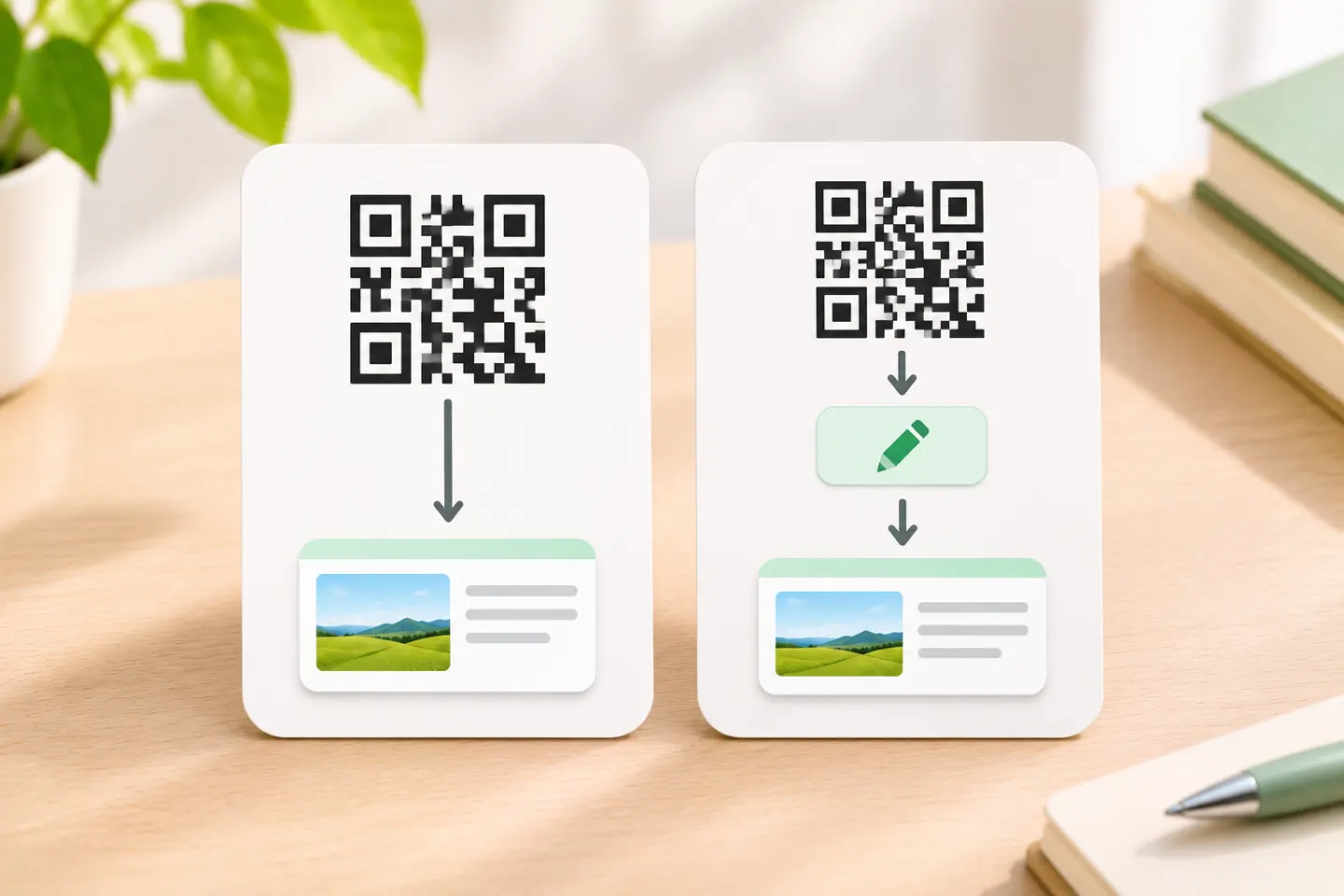
- Static: the QR pattern contains the URL you supply. Changing that encoded URL requires a new QR image.
- Dynamic: the pattern typically contains an intermediary URL. A service changes where that URL sends visitors; it does not rewrite the printed code. [1]
These labels can be confusing. GS1 explicitly notes that everything printed on a product is physically static, even when its final online destination can change. This guide uses “dynamic” in the common marketing sense of a managed redirect, not as a separate kind of printed symbol. [3]
Static vs dynamic QR codes at a glance
| Question | Direct-link static code | Managed dynamic code |
|---|---|---|
| Can the encoded URL change in the same image? | No | No—the intermediary URL remains fixed |
| Can the final destination change without reprinting? | Through your own redirect, if you control the encoded address | Through the redirect service |
| Can content at the destination change? | Yes, if you control that content | Yes, if you control that content |
| Where would reporting come from? | Website analytics or your own infrastructure | Provider reporting if included, plus website analytics |
The URL distinction comes from Sony’s explanation and standard web redirection. Reporting belongs to the web services involved, rather than to the printed pattern itself. [1]
When a static code is enough
Our recommendation: start with a direct link when your team controls a durable web address and does not need a separate QR-management dashboard.
For example, a restaurant could encode its own menu-page address and update the menu on that page. The QR image would still contain the same URL. If the page later moves, a redirect from the original address can preserve the route to it. This is an application of ordinary website redirection, not a special QR feature. [2]
Static is therefore worth considering for:
- A business card linking to a maintained contact page.
- A sign linking to a stable information page.
- A short campaign whose destination is already settled.
Treat these as selection examples, not guarantees of permanence. Before printing, assign someone responsibility for maintaining the address.
Can a static QR code be tracked?
Yes—traffic arriving through a static link can be measured. Google Analytics documents using UTM parameters to identify campaign traffic. Applying that method to a URL encoded in a static QR code can help attribute visits to a particular placement, provided Analytics is implemented on the destination. [4]
That is website-visit attribution, not proof of every camera scan. Do not describe a campaign report as an exact count of people who scanned the image; Google’s documentation describes traffic referred through tagged URLs. [4]
When a managed dynamic code is worth considering
Our recommendation: consider a managed redirect when changing destinations without touching the website is an important operational requirement—for example, packaging used across several promotions or printed materials managed by a marketing team.
Sony describes changing the destination while retaining the embedded short URL. GS1 also describes marketing redirect services that collect scan-related information and provide analytics. Specific reporting capabilities still need to be checked with the service you choose. [1]
Before committing, ask:
- What happens after a trial or subscription ends? Get an explicit answer about whether the printed link continues working.
- Who controls the encoded domain? Ask whether you can use an address your organization controls.
- Can you leave the service? Check destination export, redirect migration, and domain arrangements.
- What does a “scan” mean in its reports? Ask about repeat requests, automated traffic, and visitor estimates.
- What data is collected? Review access, retention, and privacy arrangements before enabling reporting.
These are purchasing checks, not claims that every dynamic QR service has the same restrictions.
You can also manage your own redirect
A hosted QR platform is not the only option. Your web team can maintain a fixed source URL and change its redirect target. Cloudflare’s documentation describes the underlying source-to-target mechanism; GS1 recommends using your own domain for its Digital Link implementations. The tradeoff is taking responsibility for the infrastructure yourself. [2]
Do QR codes expire—and is dynamic safer?
For URL-based codes, separate the printed image from the online route it invokes. A direct link needs its destination to remain available; a redirect-based link also needs the redirect to keep operating. Consequently, neither label alone establishes how long a printed code will remain useful. [2]
Do not treat either label as a safety certification. The FTC warns that criminals replace legitimate QR codes and direct people to spoofed websites. It recommends inspecting unexpected URLs and protecting accounts with strong passwords and multifactor authentication. [5]
For a public deployment, our recommendation is to protect the accounts controlling the destination and redirects, periodically inspect physical signs, and check the final landing page—not just whether the camera recognizes the image.
Payment QR codes use different terminology
For this comparison, use “dynamic” to mean an editable web redirect. Keep payment and account-linking codes in their own workflows.
A practical decision checklist
Before generating the final image:
- Decide what must change: webpage content, the destination URL, or payment-transaction data.
- Choose who controls the route: your website team or a managed redirect service.
- Define measurement: campaign visits, redirect requests, or another clearly specified metric.
- Confirm continuity: document domain ownership and any service conditions.
- Test before distribution: scan the final artwork at its intended size, follow the full route, and check the destination on the phones your audience is likely to use.
These are recommended prepublication checks; no device or print testing was performed for this article.
Bottom line: choose based on ownership and workflow. A maintained direct URL may be sufficient. A managed dynamic code can make destination changes and reporting more convenient, but confirm the service’s terms before putting its URL on long-lived materials. [1]
References
[1] Sony Support, “What is the difference between Static and Dynamic QR codes?” — https://www.sony.co.uk/electronics/support/articles/00248593
[2] Cloudflare Docs, “Redirects.” — https://developers.cloudflare.com/rules/url-forwarding/
[3] GS1, “Redirection: from scan to content.” — https://ref.gs1.org/docs/2024/redirection-from-scan-to-content
[4] Google Analytics Help, “URL builders: Collect campaign data with custom URLs.” — https://support.google.com/analytics/answer/10917952?hl=en
[5] Federal Trade Commission, “Scammers hide harmful links in QR codes to steal your information.” — https://consumer.ftc.gov/consumer-alerts/2023/12/scammers-hide-harmful-links-qr-codes-steal-your-information